Kongó redony témájú infó története: pengőktől a croissantig? és a kongóvörös festékre utaló történet
A pengő magyar valuta történetéről szóló részletes áttekintést a megadott anyag alapján rendezzük egységes egésszé, kiemelve a Kongóhoz kapcsolódó címkéket és történeteket, amelyek a szövegben megjelentek.
Pengő: a magyar pénzügyi stabilitás keresése (1927-1946)
The pengő was the currency of Hungary between 1 January 1927, when it replaced the korona, and 31 July 1946, when it was replaced by the forint. The pengő was subdivided into 100 fillér. The Hungarian participle pengő means 'ringing' and was used from the 15th to the 17th century to refer to silver coins making a ringing sound when struck on a hard surface, thus indicating their precious metal content.
At the beginning of the First World War, precious metal coins were recalled from circulation. In the early 1920s, all coins disappeared because of the heavy inflation of the Hungarian korona. The name pengő was probably chosen to suggest stability. However, there was some controversy when choosing the name of the new currency, though the majority agreed that a Hungarian name should be chosen.
The denomination of the banknotes was indicated in the languages of ethnicities living in the territory of Hungary. The name of the currency was translated as follows: Pengö in German, pengő in Slovak, пенгов in Cyrillic script Serbo-Croatian, пенгыв in Rusyn, and pengő in Romanian.
Stabilitás és aranyfidés
After the Treaty of Saint-Germain, the Austro-Hungarian Bank had to be liquidated and the Austro-Hungarian krone had to be replaced with a different currency, the korona. This currency suffered a high rate of inflation during the early 1920s. A stabilisation program covered by a League of Nations loan helped bring down inflation, and the korona was replaced on 1 January 1927 by the pengő, introduced by Act XXXV of 1925. It was valued at 12,500 korona, and defined as 3,800 to one kilogram of fine gold - which meant that the pengő was pegged to the gold standard, but was not convertible to gold. In the beginning the cover ratio was fixed at 20%, later raised to 33.3% within five years, reaching 51% on 31 July 1930, before fluctuating due to the Great Depression.
Második világháború és hiperinfláció
The war caused enormous costs and, later, even higher losses to the relatively small and open Hungarian economy. The national bank was practically under government control, and the issue of money was proportional to budgetary demands. By this time, silver coins disappeared from circulation, and later, even bronze and cupro-nickel coins were replaced by cheaper metals. In one of the last acts of World War II, the Szálasi government took control of banknote printing and issued notes without any cover, first in Budapest, then in Veszprém when Budapest had to be evacuated. As a result of the war, the Hungarian economy was destroyed and the government faced large reparations and low revenue. The pengő lost value dramatically after World War II, suffering the highest rate of hyperinflation ever recorded in human history.
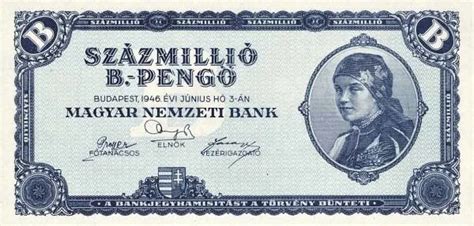
On 29 May 1946, Ferenc Gordon started issuing adópengő tax bills, and on 9 July the same year, the tax bills became legal tender. Ultimately, only a new currency could stabilize the country's financial situation. In 1926, coins and in 1941-1945, banknotes saw rapid changes due to war and occupation pressures. Hyperinflation peaked with notes up to 100 million b.-P (100 quintillion or 10^20 P) in 1945-1946. During the hyperinflation, note designs were reused, changing the colour and replacing the word pengő first with milpengő, then b.-pengő, to generate higher denominations.
Érdekességek és nyelvi megjegyzések
In 1926-1929 the first pengő banknotes and small coins were issued; later series saw security improvements and engravings by Endre Horváth. After the Vienna Award, Hungary supplied its recovered territories with money, issuing 1 P and 5 P notes in 1941 and 1938 respectively, with simple designs. In 1945, the reverse side of banknotes included the denomination spelled out in several languages representing territories Hungary had lost after World War I: Romanian, Slovak, Serbian, Rusyn, and German. The largest denomination printed was 100 million b.-P, rarely used except for large transactions.
A döntő változás az adópengő bevezetése volt, amely megkísérelte az infláció korlátozását, de a valuta értékfolyamát nem állította meg teljesen. A Kongó kapcsolódó történetszálai ebben az időszakban nem a pengő közvetlen gazdasági megoldásaihoz kapcsolódnak, mégis megfigyelhetőek párhuzamok a gazdasági nyomás és a címkék soknyelvűségének jelzése között a korabeli bankjegyekben.
Idegen nyelvek és szójátékok a kongóvörös összefüggésben
Megemlítésre kerül, hogy a kongóvörös (Congo Red) nevű színezék és a kapcsolódó történeti kontextus gyakran idézett példája a kereskedelmi és jogi vitáknak, amikor „az amerikai vagy európai vállalatok” és egyes afrikai érdekek között konfliktusok merültek fel a szabadalmak jogsértéséről. A kongóvörös fogalom az új színezékre és a festékre utal, amely a textíliákban és egyéb anyagokban alkalmazták, és amely hosszú távú piaci és jogi vitákat generált. E történeti példák bemutatják, hogyan terjedt el a nemzetközi kereskedelem és a szabadalmi kérdések árnyékában megfigyelhető üzleti marketingfogások hatása.
Vizuális és multimédiás elemek
Az információk szemléltetéséhez infografikák és idővonalak segíthetnek a pengő történetének értelmezésében, különösen a hiperinfláció és az adópengő bevezetésének szakaszainál. Rövid videóval kiegészítve a korszakban használt bankjegyek mintázatai, valamint a szabadalmi és gyártási folyamatok bemutathatók.